

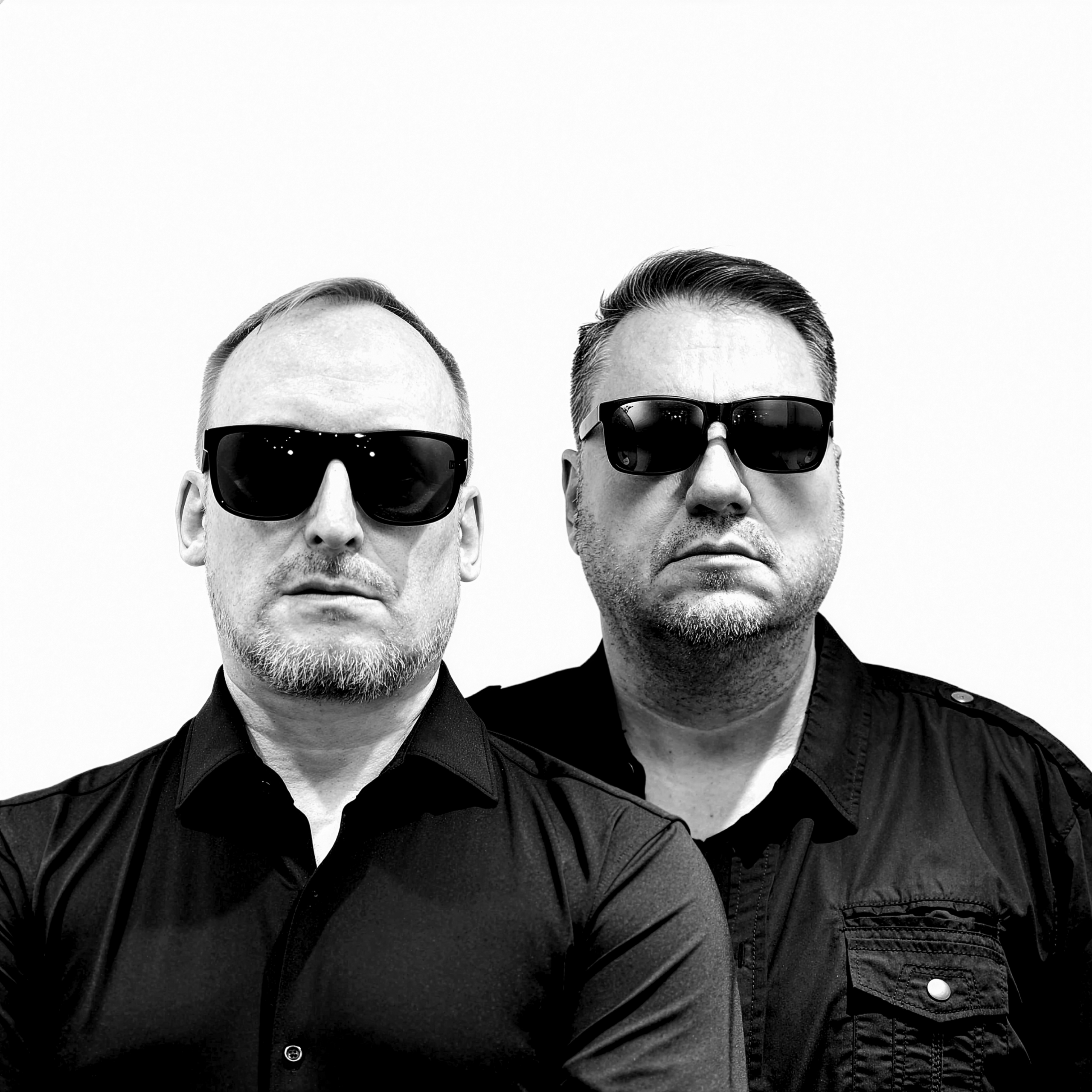
What exactly is a Sea of Sin? That depends on exactly who you’re asking. Some might say it would manifest in an almighty orgy of lust-riddled people, while others might say it’s more cardinal than that sticking with murder and theft and the like. But what it actually is is two dudes from Germany creating New Wave and having a fun time whilst doing it. Join our esteemed guests Frank and Klaus as they tell us all about Sea of Sin in this edition of INTRODUCING.
Give us a brief about Sea Of Sin. Who are the members and what are your roles?
Frank: Sea of Sin is essentially a duo consisting of Klaus and myself, Frank. We’ve known each other since our gymnasium days in the mid-1980s — a friendship spanning more than 40 years now. Klaus handles the production, mixing, and instrumental arrangements from his home studio in Hamburg, while I focus on songwriting, vocals and lyrics from Stuttgart.
Klaus: Our setup works beautifully across the Hamburg-Stuttgart distance through file-sharing and our established collaborative process. Frank continuously develops new song ideas and demos, which we then jointly select and refine. I create the rough versions and handle the technical production, while Frank develops his vocal lines and crafts the lyrical content. We operate completely independently—100 percent autonomous without a label, distribution or booking agency.
When did you first launch Sea of Sin and was it born from other projects?
Frank: Sea of Sin was actually born from necessity and disappointment. We originally founded our first band called Covent Garden in the early 1990s when we were 18 years old, together with our school friend Dirk. We had our first CD fully produced and pressed by 1993, but just before release, another band with the same name came forward and claimed naming rights — they had existed longer than us.
Klaus: That was a huge setback for our initial enthusiasm, but we didn’t let it defeat us. We had to scrap everything and rebrand as Sea of Sin in 1994, releasing our debut album “Watch out!” with a successful Dortmund label. After an EP “Illuminate” in 1997 (produced by Heiko Maile from Camouflage) and a “Best of” collection in 2002, the project gradually faded in the early 2000s, though we never officially disbanded.
Frank: The real restart came in 2017/2018 when we dared to begin again. Since our comeback, we’ve released four albums and two remix compilations. We’re totally grateful for everything that has happened since then. It’s been an incredible journey of rediscovery and evolution.
What bands and artists influenced you for Sea of Sin the most and why?
Klaus: We’re children of the 1980s, so our hearts beat especially for bands like Camouflage, Depeche Mode, OMD, The Cure, New Order and Ultravox. These bands had already built a large musical foundation of great songs and albums with recognition value. It was ultimately the music and aesthetics of these acts that inspired us to make our own music and write our own songs.
Frank: Three albums that particularly shaped us are “Violator” by Depeche Mode, “Disintegration” by The Cure, and “Voices & Images” by Camouflage. But we should also mention Wolfsheim with their debut album “No Happy View”. What united us was our love for New Wave, Synthpop, and Darkwave, but we both always had quite a broad musical taste.
Klaus: From the beginning, we integrated guitars and refused rigid genre boundaries, we found them boring even then. The label “synthpop” doesn’t really do us justice because we’ve always incorporated rockier elements and diverse influences into our sound.
If you could pick a single song from your discography to explain your music, which song would you pick and why?
Frank: That’s incredibly difficult to say, because our catalog spans over 30 years and shows a remarkable evolution. If I had to choose one song that best captures our essence, I’d probably pick “Bang Bang Bang” from the new album. It demonstrates our willingness to push boundaries, address dark psychological themes without glorifying violence, and showcase our evolution beyond traditional synthpop. The song incorporates many stylistic elements that define our sound; it’s dark, profound, cinematic, yet still danceable and somewhat playful.
Klaus: “Bang Bang Bang” perfectly represents how we’ve always refused to stay within rigid genre boundaries. It has the driving, rocky uptempo style that shows we’re not just a synthpop band, while still maintaining that melancholic, atmospheric quality that has always defined us. The song addresses inner demons and psychological struggle — themes that run through much of our work.
Frank: What makes this song representative is that it’s part of a conceptual arc but also stands alone powerfully. It shows our ability to take complex emotional territory—violent fantasies born from overwhelming frustration—and translate that into compelling music that’s both accessible and deeply meaningful.
Klaus: Another good example would be “Dark Revelations,” also from the new album, but we wanted to focus on just one song.
Is there a central theme behind the new album?
Klaus: Absolutely. “The Shape of a Lonely Soul” serves as the thematic bracket for all songs that made it onto the album. The title stands symbolically for the turbulent times in which we live, characterized by prevailing political and social upheavals, and the struggle against the hopelessness and despair that many perceive in modern life.
Frank: The lyrics focus primarily on themes of hopelessness, inner emptiness, overwhelm, and building anger in an increasingly polarizing society. Recent years have demanded extremely much emotionally and psychologically from people worldwide — from the Corona pandemic through the Ukraine war to escalating geopolitical tensions with unpredictable economic and existential consequences.
Klaus: Additionally, AI is increasingly causing uncertainty among people. All these emotions we tried to pack into a sound garment that fits us and is independent. The first four singles “Faith!”, “No Excuse”, “Bang Bang Bang”, and “Save Me” specifically describe the descent of the soul from fading faith through emerging anger to violent fantasies and the search for redemption.
Take us through the genesis of a song or album? Do the lyrics and concept come to you first or do they come about after the music?
Frank: Songwriting isn’t a consciously controlled process for us, depending on mood and daily form, completely different song ideas emerge. I work practically continuously on new song ideas and capture them as demos, which I share with Klaus. We process everyday impressions, experiences and emotions through our songwriting.
Klaus: Our production process has been established over many years. Frank creates the initial demos, then I start creating rough versions in my home studio in Hamburg. We work iteratively on the songs until we’re happy with the rough version. During this production phase, Frank develops his vocal lines and deals with the lyrics of the songs.
Frank: The album title “The Shape of a Lonely Soul” actually crystallized later, after it became clear to us in which thematic and lyrical direction the new songs were going. So the music often comes first, but the concepts and themes emerge naturally from the emotional content we’re processing. It’s an organic process where music and meaning develop together.
Klaus: Then we go to “Studio B” in Stuttgart with Thomas Banse for professional vocal recordings and additional guitar lines. After everything is recorded, I return to my home studio for final production and mixing, then it goes to Calyx Mastering in Berlin.
What’s your current favorite song, band, or album within your scene? And vice versa, what do you enjoy the most that’s completely opposite of what you make?
Klaus: We have a close friendship with Psyche now. We recently implemented our first “Synth & Wave Pop Night” in Hamburg at LOGO together with them, which drew almost 200 paying guests. That’s anything but self-evident in current times, and it shows there’s still a strong community around this music.
Frank: Within our scene, we continue to be inspired by the bands that originally influenced us: Depeche Mode, The Cure, Camouflage. But we also appreciate newer acts that are pushing the boundaries of dark electronic music while maintaining emotional authenticity.
Klaus: As for what’s completely opposite to what we make. We both actually always had quite a broad musical taste. We appreciate good songwriting and emotional honesty regardless of genre. Sometimes listening to something completely different can inspire new approaches to our own music, whether that’s jazz, classical, or even well-crafted pop music.
Frank: The key is authenticity and emotional depth. Whether it’s within our scene or completely outside it, we respond to artists who are genuinely expressing something meaningful rather than just following trends.
What is on the horizon for Sea of Sin? Upcoming gigs, tours, merch, videos, etc. Name it, link it, show it off.
Frank: We’re totally focused on celebrating the release of “The Shape of a Lonely Soul,” which came out on March 13, 2026. We put all our energy and resources into this album’s production last year, and we want to extensively celebrate this moment with our fans. We worked toward this for so long with incredible passion.
Klaus: We have some exciting live opportunities coming up, including the “Kielectric” festival on April 4, 2026 in Kiel. We’re always interested in playing suitable events and festivals since we love performing our songs live, though any tour has to be financially and time-wise feasible given our demanding main jobs outside of music.
Frank: For the first time, we produced a limited vinyl series alongside CDs, available exclusively through the webshop poponaut.de. The vinyl production was incredibly complex and expensive for independent artists like us, but totally worth it when you hold the finished product in your hands.
Klaus: We also produced our first music video in a while for “Bang Bang Bang” with Daniel Vossen (dvfilmproductions, Aachen), and Hans Guillermo Weidhoder (feedbackmedia Stuttgart) created great visualizer videos for the other singles. We’re continuing to build our network while staying true to our independent approach.
Frank: New material isn’t planned immediately—fans and new listeners have a lot to discover from our catalogue since 2018, plus our songs and albums from the 1990s. We remain committed to our 100 percent independent approach, which means we can choose opportunities that truly align with our vision rather than just filling calendar dates.