

Talking about aggrotech in 2026 is usually met by eye-rolls, sarcasm, and maybe a joke or two about how it had its time and is now fading away. But every single genre in the world has a dedicated following and aggrotech is no different; can’t say that it’s my personal cup of tea but every once in a while an act comes through that manages to impress me just a bit. Clockwork Echo may or may not fall into that category; I’ll leave it as a mystery. But the mystery man behind the Denver, Colorado-based project has just released his brand-new single and decided to bless us with his appearance on this edition of INTRODUCING. Learn all about him.
Give us a brief about Clockwork Echo, please. Who are the members and what are your roles?
Clockwork Echo is a Denver-based next-wave aggrotech project. In the studio, I handle the writing, production, programming, vocals, and overall creative direction. Live, it expands into a band built around the material, so the lineup has evolved over time rather than functioning as a traditional fixed-membership group. Aggrotech is still the foundation, but I think of it more as a starting point than a boundary. The project has gradually become an excuse to combine things that probably weren’t originally supposed to coexist — there’s a lot of metal, dub, grime, bass music, and whatever else catches my ear worked into the way I approach rhythm, weight, space, and arrangement. Somehow it all ends up in the machinery eventually.
When did you first launch the project and was it born from other projects?
Clockwork Echo started around 2018 as a side project and gradually became a serious thing around 2022. I’d played in metal bands for years before that. The electronic side actually started because I was living in New York, spending an obscene amount of time commuting on the subway, and wanted a way to make music that didn’t involve hauling around a guitar and amplifier. I’d already been listening to aggrotech and darker electronic music for a long time, so I started experimenting with electronic production. Eventually it stopped being something I was doing to kill time on public transit and developed into its own musical language. Clockwork Echo really emerged when I realized I could take the aggression, weight, and rhythmic impact I liked about metal and get there through synthesis and electronic production instead of automatically reaching for guitars.
What bands and artists influenced Clockwork Echo both lyrically and musically and why?
There are a lot, and some of them probably aren’t immediately obvious from listening to us. On the aggrotech side, some of the biggest influences have been C-Lekktor, Alien Vampires, Noisuf-X, Hocico, Combichrist, and Psyclon Nine. Different things stuck from each of them — aggression, rhythmic drive, atmosphere, sound design, all of that — but probably the biggest lesson was that electronic music could hit with the same kind of physical force I associated with metal. A lot of the other influence comes from outside industrial music entirely. Metal still shapes the way I think about aggression and arrangement, but dub, grime, and bass music have had a huge effect on how I think about low end, rhythm, space, and sound design. Kahn, Ishan Sound, Emalkay, Skepta — basically that whole lineage of UK music descended from Jamaican sound-system culture — has worked its way into Clockwork Echo pretty naturally over time.
Lyrically, I probably owe as much to literature as I do to musicians. Shakespeare and Milton are recurring reference points. Religious and mythological language gives you this enormous vocabulary for authority, rebellion, guilt, devotion, punishment, and transformation — all the fun stuff. I like taking that vocabulary and putting it to considerably less devotional uses. More generally, I think anything you hear that makes you stop and go, “Oh, that’s cool,” eventually ends up in your own music somehow. Sometimes you mean for it to. Sometimes you realize it three years later.
If you could pick a single song from your discography to explain your music, which song would you pick and why?
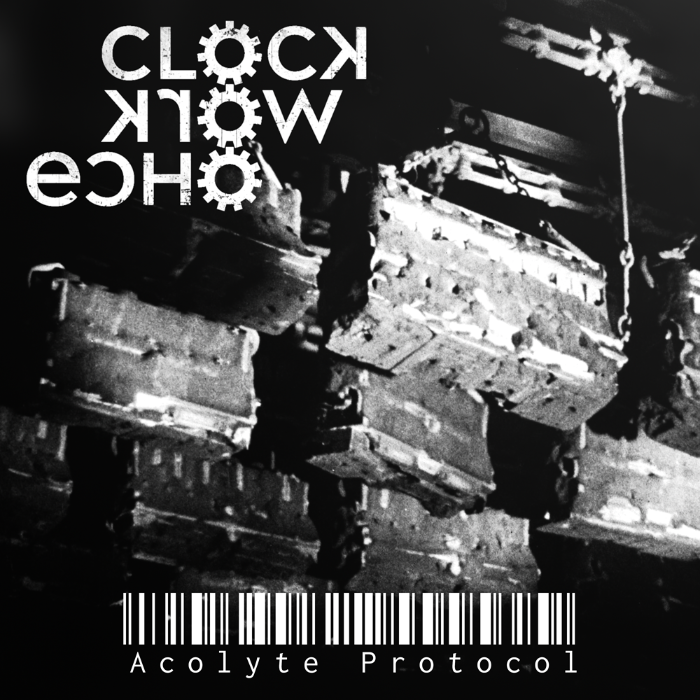
Right now, probably “Acolyte Protocol.” It feels like the clearest representation of where Clockwork Echo is going. It has the aggressive electronics and distorted synthesis you’d expect from aggrotech, but there’s a lot of the way I think about metal in the arrangement — weight, impact, making certain moments actually hit — while the low end and use of space pull pretty heavily from dub and sound-system music. It represents the lyrical side pretty well too. The song deals with fascism, complicity, violence, and consequence. And yeah, in case there’s any ambiguity about where I stand on that sort of thing, go read the lyrics. The video isn’t exactly subtle about it either. Beyond that, I’m not terribly interested in stopping the song to explain the thesis to you. I’d rather create the image, put you inside it, and let it speak for itself.
Is there a central theme behind the work that you’ve done?
There’s not one continuous narrative, but there are definitely things I keep circling back to. Power, obedience, complicity, faith, violence, consequence, ritual, and the machinery people build around those things come up a lot. I’m fascinated by the point where somebody stops merely existing inside a system and starts actively participating in it — particularly when obedience becomes something they can convince themselves is virtuous. That’s probably also why religious imagery keeps showing up. Saints, martyrs, acolytes, gods, devils, confession, punishment, salvation — those are incredibly useful symbols when you’re writing about power and human behavior. I’m generally using them as vocabulary rather than making any particular theological argument. There’s usually a healthy amount of contempt in there too. I’ve never been terribly interested in reassuring anybody.
Take us through the genesis of a song or album? Do the lyrics and concept come to you first or do they come about after the music?
Usually a song starts with either something I hear in my head, a riff or progression I stumble across while playing, or just opening Logic and experimenting until something interesting appears. That last one is almost like building with Legos or playing Minecraft in Creative Mode — put things together, break them apart, change the sounds, and eventually something starts suggesting where it wants to go. The harder part is turning that initial idea into a complete arrangement. I really dislike predictable verse-chorus structures, so I’m usually trying to figure out how to take the listener somewhere unexpected without completely losing the plot. I tend to think in terms of rhythmic identity, density, harmony, mode, space — all the different ways you can move from one section to another without it feeling arbitrary. Sometimes I’ll actually sit down with pencil and paper and map out a bunch of different ways to get from one part of the song to the next.
That’s basically how I use music theory: not as a set of rules, but as a toolkit for figuring out how to make some weird idea actually work. Sound design is part of the composition too, particularly with drums and bass. I tend to think of a kick as impact, a snare as punctuation, and bass as mass or pressure. Even the empty space around those sounds matters. Sometimes the question isn’t just “What notes belong here?” but “What needs to hit here, and what needs to disappear beforehand to make it hit harder?” Then I keep pulling the arrangement apart and rebuilding it until I stop finding things that annoy me.
Lyrics usually come later. Historically they were almost an afterthought: the music already had a mood and a personality, and eventually I’d get to the point where I had to figure out what the hell I was actually going to say over it. That’s changed somewhat as I’ve gotten more interested in poetry. Sometimes I’ll write something separately and realize later that it belongs in a song, but I still almost never build the music around finished lyrics. Usually the two develop separately and meet somewhere toward the end.
What’s your current favorite song, band, or album within your scene? And vice versa, what do you enjoy the most that’s completely opposite of what you make?
What scene are we talking about here? [laughs] I mean, the latest Ministry record slaps. The new Combichrist is great. ESA put out a killer record last year. The new Hocico is excellent. Genghis Tron just released something, assuming we’re stretching “the scene” far enough for that to count. I could keep doing this for twenty minutes and still forget somebody obvious. Outside of that? Fuck, man. Yesterday it could’ve been dub, grime, black metal, Parliament, Waylon Jennings, Wu-Tang, AC/DC, some weird house track, and the Cowboy Bebop soundtrack all in the same playlist. There is absolutely no curatorial integrity happening here. I don’t really divide music into “this influences Clockwork Echo” and “this doesn’t,” either. If something makes me stop and go, “Oh, that’s cool,” some part of it is probably going to stick. Maybe it’s a bass sound, a drum pattern, a vocal cadence, some weird production choice, whatever. Sometimes I know exactly where an idea came from. Sometimes I notice it three years later and go, “Oh. Right. That’s where I got that.”
What is on the horizon for Clockwork Echo? Upcoming gigs, tours, merch, videos, etc. Name it, link it, show it off.
“Acolyte Protocol” is out now along with the music video, and that’s really the beginning of the next phase of Clockwork Echo. There are several more singles planned over the coming months, leading toward a larger release in 2027. I’ve been keeping pretty busy lately, so at this point it’s largely a question of “which of these things do I actually let out of the building?” There’s plenty happening on the live side too. We’re currently working on a U.S. run for early 2027, although the exact timing and details are still moving around enough that I probably shouldn’t pretend I know more than I do. There are also a few things moving behind the scenes that could make next year interesting. Nothing I’m going to reveal yet, but there’s movement.