

What a devastating feeling it must have been for Erick Miotke. In 2011, Trial were preparing to celebrate their twentieth anniversary with a high-profile festival appearance when vocalist Torsten Schröder abruptly left the group. The planned performance disappeared with him, and one of Germany’s most distinctive and captivating dark-electro partnerships came to an end. For listeners who first encountered Trial through Zero Feeling, Secret Pain, or the cold menacing dark electro classic single Blut Und Eisen, the split must have gutted fans, especially due to the sudden circumstances, no warning no writing on the walls, just an enormous door slamming in the face of those who embraced Trial and all those that would from what should have been another fiery and fierce Trial show.
I still have fond memories of hearing Blut Und Eisen at Café Soundz in Montclair, New Jersey. The proprietor, Bob was a well-known for his long time support the scenes that catered to the underground. I’m quite sure he was responsible for creating many Trial fans from his shop. Trial’s combination of diabolical vocals and otherworldly programming immediately changed the lens through which I heard dark electro. Miotke’s approach to design was like architecture rather than song writing. Everything was so precise and flawlessly executed. Every listen could unravel parts of the process, but it could never be truly understood by anyone other than its creator. The sound was severe and unlocked hidden corridors, parallel realms, and unsettling details. Then add Schröder’s voice and the door opens and hell breaks loose with best possible outcome hell could have. Eventually all doors close but this one was way too early at the time. Together, they possessed the elusive “it factor” that made Trial essential listening rather than merely just another band.
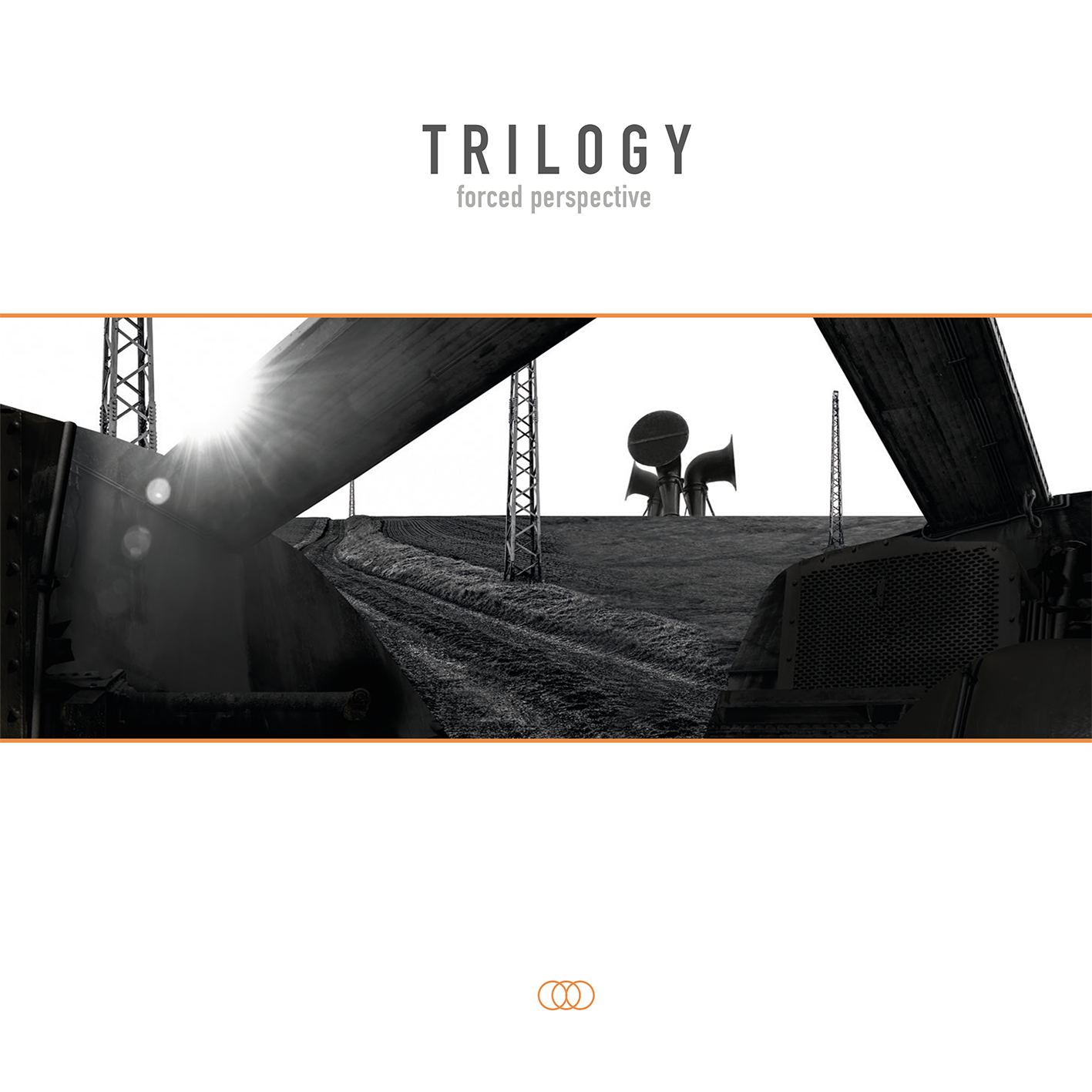
That legacy provides the natural starting point for Forced Perspective, even though the album refuses to remain trapped there. Miotke met Jens Müller, formerly of Human R3source and already a devoted Trial listener, late in 2011. Their collaboration became Trilogy—a project designed to respect Trial’s foundation while experiencing a sound that ultimately built a separate structure on top of it. After a long run of singles and EPs, the duo’s debut arrives as an expansive eighteen-track album paired with EAR’s obligatory overdose of remixes titled Alternative Perspective on which every song is reinterpreted by a different artist making it a reviewer’s nightmare and a consumer’s dream.
The album’s title is especially fitting. Forced Perspective makes an object seem nearer, farther away, larger, or smaller depending on the viewer’s position. Trilogy utilize this approach with musical history: from one angle, the shadows of Trial appear close enough to touch; from another, the details reveal a different band morphing through a modern production environment.
That shift in perspective naturally raises the obvious question: does Forced Perspective simply sound like Trial with a new frontman? The answer is predictable, both yes and no. Müller’s forceful delivery sometimes recalls Schröder’s guttural power but his execution has a different groove with modern touches that are tethered to the foundations that gave rise to greats of the genre. He does not mimic the past; he occupies the same region in his own way. Miotke, meanwhile, remains elite in his craft. His programming is still complex, dark, and deeply multi-layered, but the production is broader and perhaps a bit more polished than Trial’s early works.
Trilogy embraces the soul of the past and those qualities merge with the contemporary vibes and come fully into focus on Moon Of Decay, one of the album’s defining moments. It churns at a measured pace, releasing waves of icy atmosphere while Müller’s voice cuts through with the precision of a surgeon’s blade. A recurring spoken sample sounds like a Crowley ritual and deepens the sense of occult unease. The track carries the heart of Trial’s most ominous work, but its spacious boundaries make the darkness feel inviting from all angles.
From that slow, glacial tension, Catastrophe raises the BPM without sacrificing detail. Programmed sounds perfectly merge with the vocal lines like the inner the working of high-end timepieces. This is where Miotke’s continuity is clearest: the arrangement does not simply support the song—it lurks finding crossroads and secret trails that unravel the awe-inspiring discipline that captivates our yearning for something that moves us and defines us.
That momentum shifts with Scherben which pairs a haunting urgency with complete control. Its title means “shards,” and the music reveals a throbbing pressure, and whispered vocal aggression with different angles coming to an intersecting point and locking into what I see as the perfect blend of Trial meets Trilogy. Trial often sounded like all our nightmares coming together in wave of brutality that sounded perfect. We wanted to relive that beautiful nightmare time and time again. Trilogy took that same beautiful nightmare and restored it with a more modern touch without removing the guts that made it so compelling.
Fan fave Combat Surfer is the conduit from Trilogy’s early output to the highly anticipated album, while Someone Inside, Entombed Love, and the title track show how Trilogy has gradually evolved while expanding its emotional and rhythmic grasp. There’s a lot to take in over the course of 18 tracks, not to mention the second disc loaded with another 18 carefully curated remix tracks including Sleepwalk, Serpents, R010R, Terminal State, To Avoid, Tear!down, AD:Key, Pyrroline, Synaptic Defect, Brain Leisure, Bent, Digital Factor, T.A.N.K, Project Pitchfork, Second Disease, Mildreda, Duo and Villaborghese, each altering and breathing their souls into the chosen remix and in turn create a unique angle that only that artist could deliver. I do want to point out, Duo and Villaborghese are both projects Erick is involved in. They deliver a pulsating driving journey into the dark without the ultra-aggressive edge. Duo’s mix makes it easy to get lost in your thoughts for a little while indulging in Erick’s craft that feels like a dark Jean-Michael Jarre possessed Erick and this is the end result, while Villaborghese inflicts a moderate electro beat that bridges glitchy electronics with industrial severities. There is a decent amount of material available for those willing to explore the genesis of Villaborghese to this remix on the Trilogy Alternative Perspective disc. All eighteen remix tracks ultimately reinforce the title’s central idea: the chassis remains the same, yet each artist manipulates the tracks with their own interpretation.
Electro Aggression Records never disappoints with quality. They always max out the CD with quality offerings as well as the remix CD filled with roster artists as well luminaries from the scene and even a few resurrections for good measure. The inlay cards are usually filled with information. With over 20 plus physical releases, EAR is consistent rather than constant. You will wait a few years and then something eventually pops up. Pop goes Trilogy! Go get it and enjoy!