

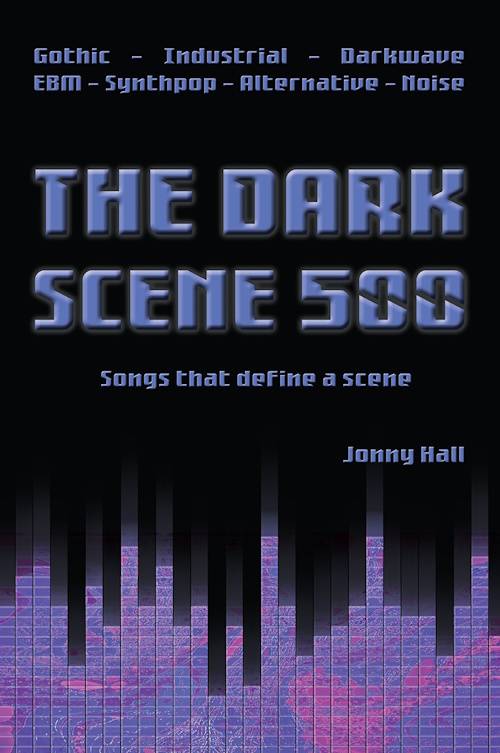
Hey Jonny! It’s been quite some time since you last wrote for Brutal and I’m glad things have gone so well for you. How did the concept for the book come to you, and why did you choose five-hundred songs to cover?
The first objective was to write a print-to-paper book about scene music. Online writing is still valuable when it’s done well, but it’s by its nature short-form and ephemeral. I wanted to create something longer lasting. My first idea was to create a shorter book about UK scene bands from the early 1990s to the present day, but after an initial round of research and a half-finished chapter, I realised I couldn’t make the story sound exciting in written form. This occurred late 2019 to early 2020. You might have thought the COVID lockdowns would have been a perfect time to get some solid writing in, but the lonely, listless and repetitive nature of those times killed any creative vibes. I initially did a run of Facebook posts about iconic albums but even that ran out of energy.
Fast forward to late Summer 2021. I’d received some much needed therapy for underlying mental health issues (long predating the pandemic) and decided to have another go. I spotted an old book on my shelf, covering the 500 greatest heavy metal songs. It struck me that I should write such a thing myself, but this time about scene music. Mine was not a direct copy of the concept, for reasons we’ll cover later, but 500 seemed to be the right number to create a substantial book that was still of readable length.
I suppose one question lingering on my mind is what initially drew you to industrial music in the first place? What kind of empowerment did it give you and what about it moved you?
My first musical love were chiptunes from 8-bit video games. I’ve still got a chiptune player on my phone today but ever the deviant, I prefer the Atari POKEY over the Commodore SID. My next step was things like Jean Michel Jarre and Vangelis – their use of sonic texture and layered production still mean a lot to me, even if I was getting into their work at a time (early 1990s) where this sort of thing was dead in terms of popular interest, at least in the UK. I didn’t enjoy the chart music you heard in everyday life whether you wanted to or not, and the heavy metal played by my friends in my D&D group didn’t click either, at least at the time.
April 1996. One of my D&D friends “accidentally” leave a copy of NIN’s The Downward Spiral round my house after a gaming session. Our of sheer curiosity I listened to it. I hear the lyrics, I hear those Reznor sounds, never sure which was synth and which was guitar. It slowly dawned on me – these were the words and this was the sound I was unknowingly looking for all along. I didn’t realise music could do this, I didn’t realise song lyrics could cut this deep, I didn’t realise guitars and electronic could co-exist in a manner this impactful. I was hooked.
In an age where not everyone had online access and we were decades away from Spotify, it wasn’t possible to expand my knowledge of industrial much further at the time – Marilyn Manson and Fear Factory were the closest I could get. As it happened, there was a brief period where chart music WAS of interest – dance acts like The Prodigy, Underworld, Aphex Twin and Leftfield were easier to come by so I spent a couple of years on that backpath. Then I picked up a 2nd hand CD single by Front Line Assembly, solely on the knowledge that one of them produced the ‘Demanufacture’ album. The song was “Mindphaser” – it immediately transferred me to a dystopian near-future where cybernetic machines were on the verge of taking over humanity. I immediately knew THIS was my kind of thing.
Shortly after I checked out London’s second-hand record shops, discovered Ministry, Nitzer Ebb and Front 242 (having unknowingly heard and liked 242 via an Atari ST soundtracker several years prior) and from this point there was no turning back.
Choosing 500 songs seems like a massive undertaking considering the industrial scene’s massive 50+ year history. How did you decide which songs were worth covering? How did you organize it?
My first decision was that it wasn’t going to be an poll. The 500 heavy metal songs book I read tried that and it results in a work top-heavy with entries on stalwarts like Black Sabbath, Iron Maiden and Led Zeppelin. Influential and iconic as they were, subsequent developments, particularly those from places like Scandinavia and Germany, were pushed into the background. I was fairly sure if I tried a poll, most of the book would have been dominated by Depeche Mode, Cure and Sisters tracks, with maybe some NIN and one VNV Nation remix sneaking in. Most of the books about scene music and even many of the online articles are dominated by the most popular bands from the English-speaking nations, covering a period from the late 1970s to the early 1990s and recent material skipped over quickly, dismissed as irrelevant or not mentioned at all.
My next decision was that there would be no ranking at all. Such an approach would be too subjective. I instead hit upon the idea of dividing the book into relatively broad genres, and telling the story of each chronologically via notable recordings. It took a couple of months to assemble a list of notable projects and their most significant recordings, drawn from countless sources – past festival lineups, DJ playlists, the bands own live setlists, online listening metrics – in some cases I had to go with the knowledge or at least gutfeel that this song was the right one to include, or at least the understanding that it had a story to tell. I enforced a three-song limit by any one band or artist – this allowed me to cover projects with multiple creative phases without letting the big names dominate the narrative.
The list was assembled and prioritised with the rather tedious use of a MS Excel spreadsheet, the “long list” ending up with around 1300 songs. I whittled it down to 500 songs that would get full entries and another 500 to list in the sidebars, but I was adding and removing songs all throughout the process on a strict “one in, one out” basis. Even at the editing stage we were reshuffling the chapters to balance the content. I never claimed my list is the one definitive list of 500 scene-defining anthems, but I like to think I made a good case for the ones I eventually covered.
Perhaps this is answered in the book already and mayhaps this is a bit of a difficult question to answer, but what to you is the single-most influential song in the history of industrial music and why?
Tricky one. Many of the most influential recordings from the early days of industrial were highly innovative in terms of concept and sound design, but they can’t in the strictest sense be defined as ‘songs’. Conversely, a lot of the most memorable scene anthems have to tone down any experimental urges in order to get any kind of attention. So I’m going to go for Front 242’s ‘Headhunter’. The central riff was a happy accident caused by a wrongly-loaded sample, the underlying lyrical theme has some rather surprising origins and the accompanying video is a surreal mindbender (egghunter?). Yet in the middle of it all is one of the most rousing, call-to-arms refrains we have to offer. It’s a song that unites so many of the concepts that make our scene what it is.
A lot of people like to say that the glory days of industrial music are over, and that nothing that comes out in the modern day compares to that of the past. This is something I repeatedly refute. I think there’s more to come. What is your stance on the matter?
I admit I was worried at one point, back in the early 2010s. The industrial scene over-delivered on aggrotech and hard dance influenced styles. There was a drop-off in exciting new bands coming through the system and making it onto lineups and DJ playlists. A number of scene tastemakers and narrative-setters were saying things like “industrial is over – if you like hard electronics, listen to dubstep instead”. The wub-wub-wub started cropping up all over the place like the musical equivalent of Japanese knotweed, countless producers crowbarring Skrillex-style bass drops into every imaginable song in the hope of retaining relevance – artists able to apply those techniques with more discretion were thin on the ground. When too many people jump on a bandwagon, the wheels will soon fall off. Myself, I spent much of this time DJing whichever sets didn’t require me to play this sort of thing, with most of my bookings requiring a ‘retro’ style of one kind or another. As a result I was spending more time filling in gaps in my collection than hunting down new music.
As it happens, the next generation of exciting new music was already being created. You had to look for it but it was there. Kontravoid and Youth Code were taking classic EBM and electro-industrial concepts in new directions. Lebanon Hannover and Cold Cave put a new spin on the borderlands between post-punk and darkwave, yet Agent Side Grinder and Ash Code had their own ideas for how to re-invent this particular stylistic fusion. Pharmakon, Prurient and Street Sects were exploring extremes not charted since the early days of industrial. The likes of Empathy Test revived moody synthpop for a new generation, She Past Away made gothic rock sound fresh once more, and from a part of the world where no-one expected to hear it. One band who really took off were Kite. I first saw them playing a three-quarters full Wave-Gotik-Treffen backwater – now they’re a major draw on the main stage.
As for the next big thing, I’m not sure who or where it’ll come from, but there’s bound to be someone out there with a good idea and the talents and means to get it recorded and heard by the outside world. The major labels and big-name promoters aren’t interested so people like us will have to make sure they’re heard by the right audience, though I’m concerned that the costs and legal complexities of touring are only going to increase in the next few years and whilst it’s not as bad as it once was, there’s still too much ‘gatekeeper’ type activity going on. The world is erecting more barriers than it’s tearing down right now so we need to get creative.
Now that the Dark Scene 500 is officially out, what’s next for you? Are you going to continue to write about the scene? Start your own blog? Podcast? What does the future look like for Jonny Hall?
I hope to write about scene music again, although I’ll likely wait until I’ve pushed the current book as much as I can, so don’t expect anything new creation-wise until 2026. I have a number of ideas for follow-up projects. I’ve been watching a couple of YouTube channels where middle-aged men talk about the history of classic rock and I thought “I could do that, but make it scene friendly”, though I could use some help sorting the technicalities of that one out. There might be some shorter-form content to come from me, maybe featuring the songs that didn’t quite make it into the book. I have a few ideas about how to achieve this.
I’m still just-about functioning as DJ Terminates Here via my sets at Work! (To Live), but I’d love to play some long genre-spanning sets at some stage, something I last did to celebrate my DJing 10th anniversary in 2018. I thought such sets might help promote the book but there isn’t much opportunity to do that in the UK scene right now – even the larger events now rely on multi-DJ lineups where everyone’s booked to represent their speciality genre and finding venues and clear periods to run my own events is difficult.
I haven’t counted out writing another book one day as there’s several other topics I believe could use a deep dive, but I’d only attempt it in collaboration with a suitable publisher who’d be open to discussing my ideas and providing some insight into which ones have potential. In terms of self-publishing, The Dark Scene 500 is a “one and done” project, one of life’s biggest boxes ticked off. I have neither the money nor personal capacity to go through the whole process again without some form of backup. Given the right people to work with, however, and who knows what might come next.
Lastly I’d like to thank you for your time. I leave the space below for anything else you might want to say.
I hope this project inspires more people to write books or other long-form text about industrial, gothic and darkwave music, particularly concerning the eras the more established writers ignore or at best brush over briefly with little enthusiasm – almost everything post-1991 and most of the content from continental Europe and indeed anywhere else outside the UK and North America. Sites like Brutal Resonance do an important job in monitoring the cutting edge and pushing new developments, but we also need people to look back and remember “Why did this band, song or style matter?”.
The Dark Scene 500 is available for purchase in digital and physical formats HERE.