

Give us a brief about your band. Who are you and what do you do?
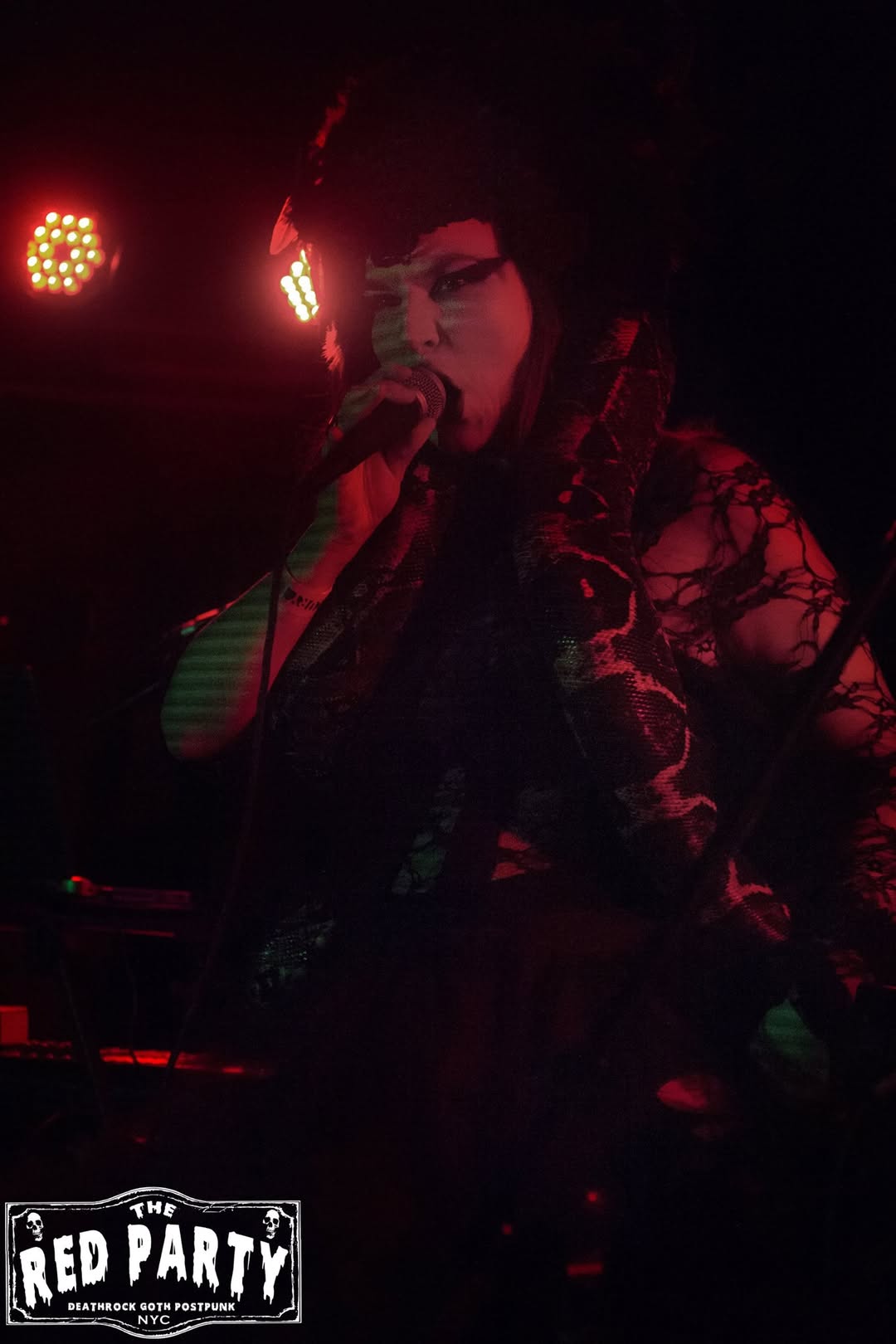
I’m K Kalliope, founder and lead singer of dark electro band “The Sedona Effect”. Inspired by the gritty extremes of my new digs in New York City, I officially started the band in 2013 as a solo project, involving several very talented musical collaborators in the US and Europe, shortly after my move to Brooklyn. With its industrial elements, dark lyrics, and beats that pulse between EBM and Dark Wave, the Sedona Effect is a unique mix, “a wild one” as Belgium magazine “Luminous Dash” called us in a recent review. I come from theater, and that echoes in our theatrical shows. The Aquarian called “The Sedona Effect” every bit a performance art project as it is an EBM band.”
When did you first launch the project, and how has it come along since?
When I moved from London to NYC in 2011, I was inspired by its grittiness and felt that the only way to express that was through electronic music. But I had never created electronic music myself, only contributed vocals to friend bands in Germany. My time in London was heavily focused on classical music and singing art songs from Debussy to Schubert, and I knew I wouldn’t be able to make that pivot on my own. Serendipitously, I found my first collaborator, Preston Krafft, in my first month in the city, and we hit it off. “Cross the Line” and “Stardust” are from this initial time when “The Sedona Effect” didn’t have a name yet and consisted of us tinkering around with a microKorg, an electronic Allegro piano, a keyboard with 200 preset sounds, and GarageBand. It was a wonderful, new, and exciting world. We wrote a lot and tested the songs at open mic nights at a fabulous place (now gone) called “Goodbye Blue Monday” in Bushwick. I moved a lot in my early days in NYC (slumlord galore!), and the move to Bushwick brought a lot of inspiring connections. Coming from theater, it was important to me to keep up with that besides my musical endeavors. Interestingly, meeting performance artist Matthew Silver (notoriously known for his fart art), who was a regular at “Goodbye Blue Mondays,” triggered a second important musical collaboration. Matthew curated a show at “Bizarre Bushwick” called the “Circus of Dreams” and invited me to perform. I created a 30-minute interactive performance piece that explored how allowing true feelings creates fragility. I transformed into a creepy doll that could only say “I love you”, which suddenly sprang to life and interacted with the audience. The doll, only equipped with “I love yous,” could only learn new words and sentences (and, as the piece progressed, feelings) based on these audience interactions. It was about the transition from an empty phrase to true meaning, an ode to human feelings, the vulnerability they bring along with joy and beauty. I needed a song for this piece and chose Gloomy Sunday. Around the same time, my friend Matt Hart from London, UK, also decided to make electronic music, and when I told him about the performance piece, we decided to collaborate on an electronic version of “Gloomy Sunday”. Later followed by two more collaborations, “I Burn” and “Evolve Devolve”. We exchanged files across the ocean. Matt was much further ahead with gear and tech, and I learned a lot from this exchange. The time had come to give my project a name, and after some dedicated research, I landed on “the Sedona Effect” after reading the article “The Sedona Effect: Correlations between Geomagnetic Anomalies, EEG Brainwaves & Schumann Resonance”. I was intrigued by a potential correlation between spectral peaks in the extremely low frequency portion of the Earth’s electromagnetic field spectrum and its effect on humans. The connection of anomalies in the electromagnetic field of the earth and an inner ear receptor that changed the way people feel when coming to Sedona, feeling healed, awakened, or enlightened, was a great concept for my electro band, which was aiming to evoke feelings in the listeners through audio waves.
I went on to make a music video for “Cross the Line” involving many friends from the NYC Goth scene and friend bands in the shoot, shortly followed by the release of “Gloomy Sunday” and then the EP “Cross the Line” on Bandcamp. A friend of mine said I should connect with Athan Maroulis to get my music out there, and funnily enough, I independently met Athan at a Mona Mur & En Esch show, and we hit it off. This meeting resulted in me joining his band NOIR and Athan becoming an important mentor for my Sedona Effect endeavors, connecting me with several compilations such as Electronic Saviors, the Unquiet Grave, and Intravenous Magazine‘s Blood Pack compilation to get the music heard.
The next big milestone was playing live. NYC is a transient place, and I decided from the start that instead of trying to find stable band members, I’d be open to anyone I clicked with, wanting to collaborate for one gig, one song, one video. I was lucky to have several incredible people staying with the band for a good while: Nicole Eres (Crimson Brule), Phyzel Alhammdani (Acrassicauda), Christian Dryden (The Ritualists), and J Dallar (The Wild Blue Yonder). The transition to live music wouldn’t have been possible without them. After the Sedona Effect’s first incredible show at the Knitting Factory with the Ritualists (formerly known as Starbolt 9) and Thorazine Unicorn, many gigs followed, including at the Highline Ballroom, the Mercury Lounge, Bowery Electric, the Delancey, and the House of Blues in New Orleans, as part of the Endless Night. Highlights for me were the music video release of “Gloomy Sunday”. I put together a concert in the style of a Victorian sideshow at the Slipper Room in NYC, with the showing of the “film” (aka music video) as the high point. Think Lumiere Brothers. True to my roots in theater, I wrote the script for the ringmaster and cast and directed an actor. The setting was the year 1895, and the sideshow advertised the showing of “the film” with the sensationalist morbid fascination that the 1930s newspapers reported about the phenomenon of about 100 people taking their lives supposedly after listening to the song “Gloomy Sunday” (though no direct links could be established). It made a fascinating backstory for the concert, where each song was presented as its own sideshow act. This show and the annual “Gothic Vampire Cruise on the Hudson”, my immersive theatrical Halloween extravaganza aboard a 150ft historic sailing ship, allowed me to bring theater and my music back together.
During COVID, live performances came to an involuntary halt, and I made the decision to focus on the full-length album. I felt that, besides individual releases and compilations, there needed to be a full-fledged album to promote before returning to the stage. I couldn’t have done it without a crucial collaborator: my partner J Dallar, who joined the band in 2016. J helped me to level up the sound and the songs over the years. He brought incredible audio engineering expertise, top gear (little did I know when I started!), and a remarkable ear, in addition to being an amazing multi-instrumentalist. 10 years is a long time, but I did not want to re-record everything; I wanted to layer and preserve the process. After many gear upgrades, years of tinkering around with sound and beats and orchestration, and getting some of the early files repaired, it’s now out in the world, a little time capsule with many imprints of the journey.
What bands and artists influenced you the most and why?
Oh my, that list is long and comes from a vast variety of different musical genres. For “The Sedona Effect”, I would say NIN, Portishead, Radiohead, Tori Amos, PJ Harvey, Bjork, David Bowie, Garbage, IAMX, and VNV Nation take the lead, but I would not be able to leave out the entire canon of classical music I grew up with. I realized when I was working with musicians in NYC that my approach has been very much shaped by classical music.
David Bowie has been an inspiration since my early teens. The first store-bought tape I possessed was “Changesbowie”, why? The music, the theatricality, the personas he would slip into, he wasn’t stagnant, but kept evolving and changing his style, reinventing himself over and over. NIN and Radiohead for their incredible sounds and beats that excited me. Tori Amos, Garbage, Bjork, PJ Harvey, and Portishead for their strong singing style and their unique and distinct sound. And as someone writing songs on the piano for the most part, Tori Amos has a special place. VNV Nation and IAMX are some Goth club favorites that always get me to dance and marry deep lyrics with club beats.
If you could pick a single song from your discography to explain your music, which song would you pick and why?
I don’t think I want to explain my music. I’m much more interested in what it evokes for the individual. I was inspired by my surroundings, the grittiness, the extremes, the nightlife, darkness, sexuality, and I wanted to learn new ways that I felt were fitting to express it. I had concepts of the dark side of femininity and borderline experiences. The clash of female stereotypes, i.e of the maiden and the mother with the wild woman, the witch, the whore, the monster, and the dissonance between that and socially accepted norms. I was interested in shedding skins and different versions of yourself, of dissonance, of being pure and perverted at the same time, morphing i.e. from the lover to the monster. For me, the music echoes this refusal to be defined as either or.
What is your most recent release and what is it about?
Our first full-length album “THE YEAR OF THE SNAKE” was published just a few weeks ago on Oct 31st, 2025 on Bandcamp and explores extreme feelings, borderline situations, and the dark sides of femininity. A sexy voice and hard beats blend into distorted melodies that long for a harmony that the estranged self will never reach.
Take us through your creative process. How do you compose a song from start to finish? Where do the ideas come from?
No song is alike; every song has a unique process. For some songs, it starts with me and a piano and hours of noodling around. Some songs just come to me and manifest while I play, and the challenge is capturing them before they fade. Some songs come from sitting down with someone else and jamming, others, like “Gloomy Sunday,” start with a concept, a rigid structure, and a predefined outline of sections. During the pandemic, I started working on a cycle of songs about grief. Some of the songs existed before I realized that a theme was shaping up, and now that that’s established, I’m approaching the last couple of songs with this concept in mind to complete the cycle.
What’s your current favorite song, band, or album within your scene? And vice versa, what do you enjoy the most that’s completely opposite of what you make?
In the scene, IAMX is still a favorite, their older material just as much as their latest songs.
I have a pretty broad spectrum of music I love, with classical music being the home I grew up in. All through my childhood, we would gather around the piano and sing everything from Mozart, Debussy, Bach, Schubert, Schumann, to musicals, jazz standards, and the great American songbook, some of which is very much the opposite of what I make. As an example, Avenue Q comes to mind; the contrast of that with my own material makes me laugh.
What is on the horizon for your project? Upcoming gigs, tours, merch, videos, etc. Name it, link it, show it off.
Big things ahead. We have the full digital release of “THE YEAR OF THE SNAKE” coming up on Nov 15th, on all major digital channels. Physical CDs and shirts will be ready in December, and in 2026, we plan to return to the stage to promote the album, which you can check out HERE. And please stay in touch by subscribing to our website.